
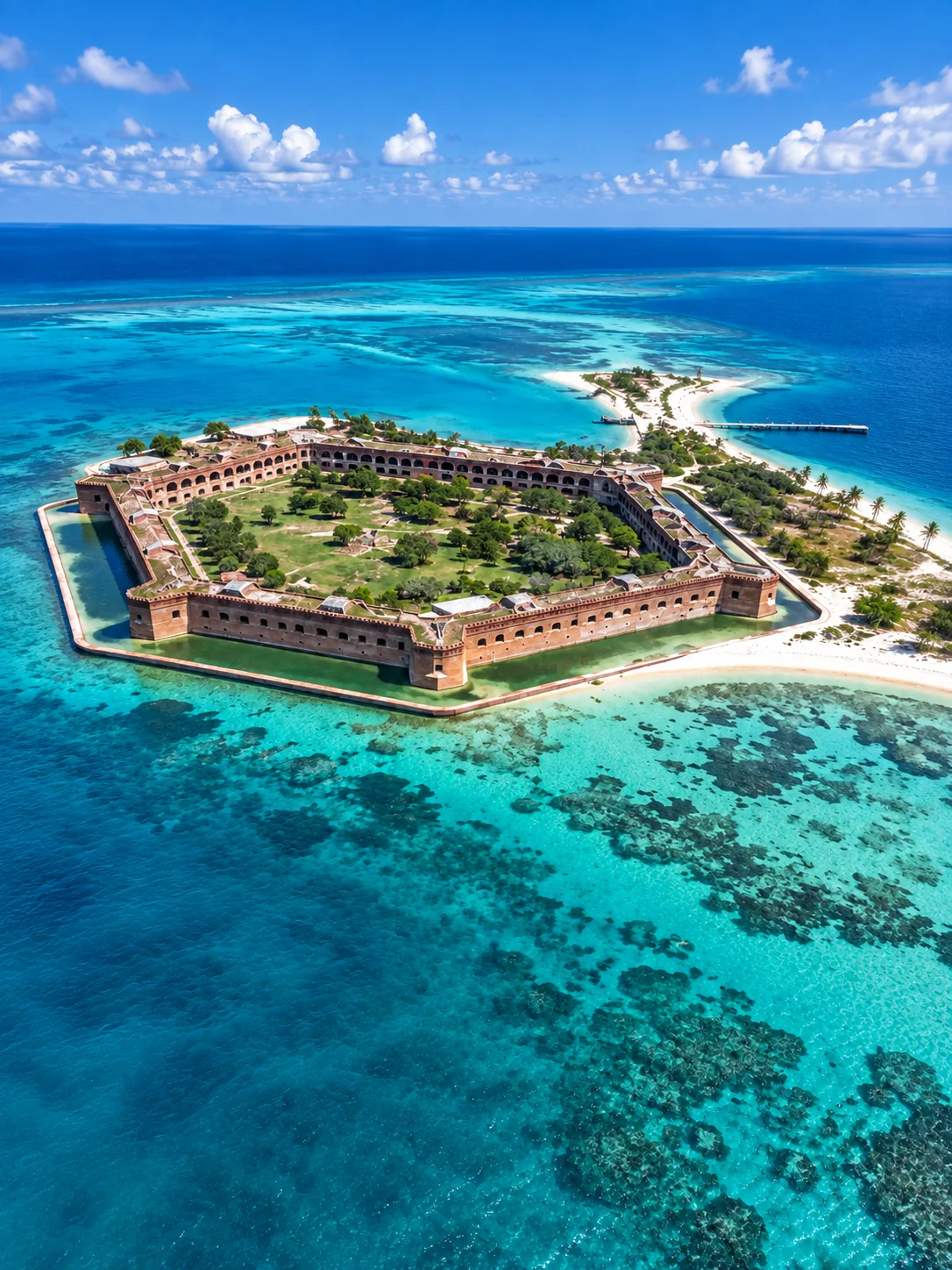
Fort Jefferson is the center of most first visits.
Fort Jefferson sits on Garden Key, which is also home to park headquarters, the visitor center, campground, beaches and snorkeling areas. NPS describes Garden Key as the second-largest island in the Dry Tortugas at about 14 acres.
The main arrival point for ferry and seaplane visitors.
A massive 19th-century coastal fort and the park's central historic feature.
North, South and East Beach provide water access.
Why Fort Jefferson was built here
The Dry Tortugas sit beside a strategically important deepwater anchorage and historic shipping route. Construction of Fort Jefferson began in 1846 as part of the United States' coastal-defense system. The fort was intended to protect the harbor and the shipping routes connecting the Gulf Coast, Florida Straits, Caribbean and Atlantic.
Nearly 30 years of construction — and it was never finished
Work continued from 1846 into the 1870s. Fort Jefferson became the largest all-masonry fort in the United States, with thousands of arches and an enormous brick structure, but supply problems, shifting ground, changing weapons technology and the Civil War all complicated construction. The Army ultimately left the fort unfinished.
The U.S. Army begins building the coastal fort on Garden Key.
Union forces hold the fort and use the harbor during the blockade of Southern shipping.
The fort holds Union deserters and other prisoners, including Dr. Samuel Mudd.
Military use declines after decades of construction and changing technology.
Fort Jefferson National Monument is established.
The area is redesignated as Dry Tortugas National Park.
Fort Jefferson during the Civil War
Florida joined the Confederacy, but Fort Jefferson remained in Union hands. Union warships used the harbor while enforcing the blockade of Southern shipping. The fort also became a military prison, primarily for Union deserters. Its best-known prisoner was Dr. Samuel Mudd, the physician who treated John Wilkes Booth after the assassination of President Abraham Lincoln.
A remote city on the sea
At its busiest, the fort was far more than empty brick walls. Soldiers, laborers, prisoners, officers, families and support staff lived on Garden Key. National Park Service history notes that nearly 2,000 people lived there at its height, making the island a crowded military community surrounded by open water.
What to do once you arrive
Walk the fort, use the interpretive signs or ranger information, see the moat wall, then leave time for the beach and water. NPS also lists a self-guided fort tour. Visitors arriving by scheduled transportation spend their park time here, so it is worth deciding beforehand how much of the day you want to devote to history versus snorkeling and relaxing.
Why arriving early can matter on a private charter
Private operators often depart Key West early enough to reach Garden Key before the ferry crowd arrives. Actual arrival time varies with the vessel, weather and sea state, so an early arrival is a possibility rather than a guarantee.
Snorkeling around Garden Key
NPS lists North, South and East Beach as easy-entry swimming areas. The park warns that there is no lifeguard, currents can be strong, visitors should not swim alone, and coral and seagrass should not be touched or stood on.
Fort Jefferson does not have normal tourist services
The park is remote. Visitors should plan around limited services and bring what they need. That makes a detailed packing guide and operator-specific inclusion list especially valuable.